
Apothecary of the Ancient Olive Groves
plus…my deep dive into DIY lotion
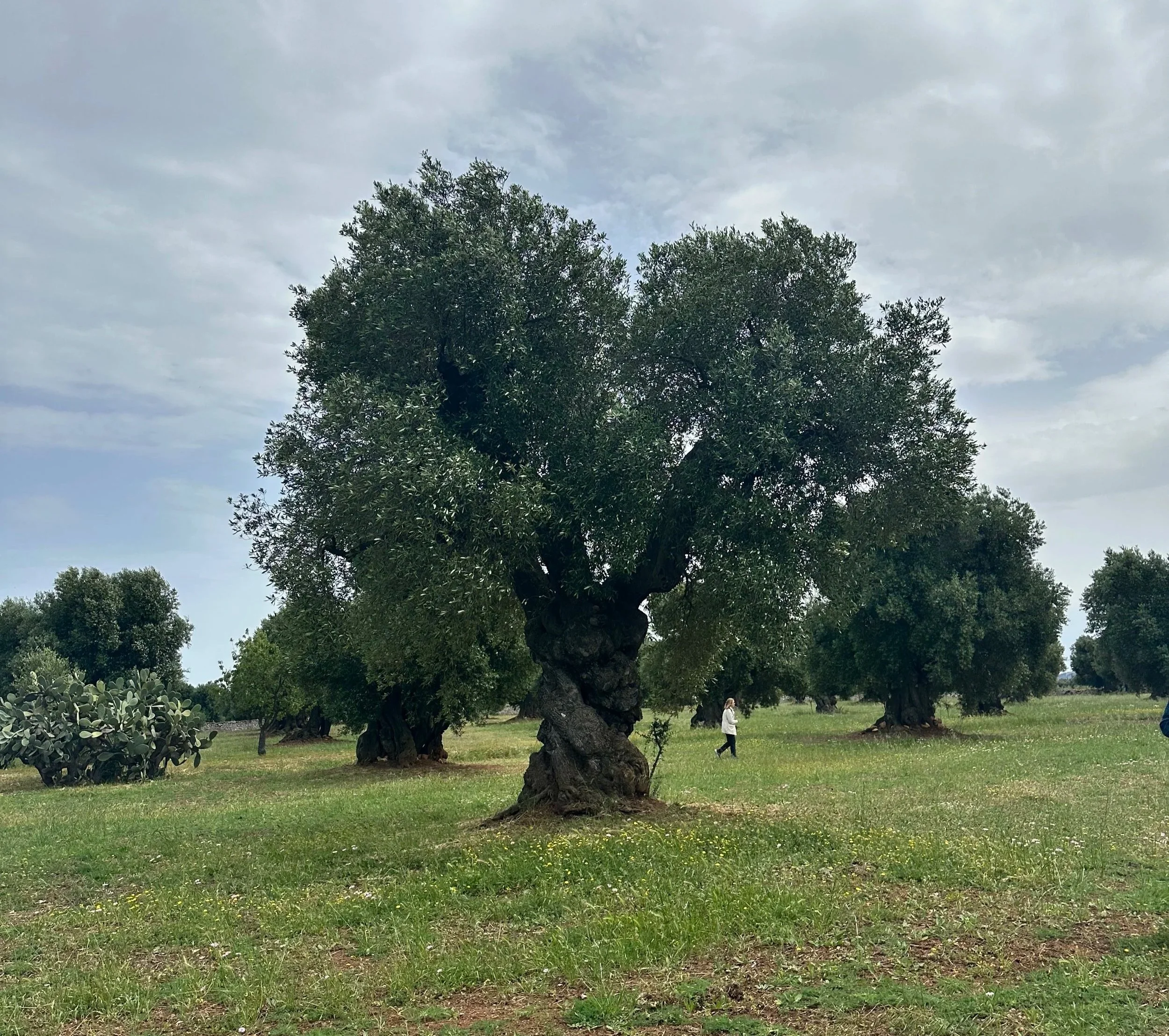
The millennial olive trees of Italy
Every once in a while I will find a product that I will share on my favorite products page. In many cases I find them while traveling…Apothecary goods make the best souvenirs! My latest travels took me back to Italy, this time to sun drenched region of Puglia on the Adriatic Coast. The heel of the boot. The region is known for its stunning coastline, and for producing more olive oil than any other region in Italy. They also have some fun culinary traditions like octopus sandwich, orchiaetta pasta and amazing burrata cheese.
We were staying in the seaside town of Monopoli but had a car to explore the countryside. One stop on our list was Ostuni, known as the white city. Like many of the towns in the area, whitewashing of the walls with lime started during the plague to prevent the spread of disease. The look became part of the local aesthetic and is still practiced today. In the case of Ostuni, the best example is actually from the outside of town looking in, as the outside City walls are kept, a vibrant white. Postcard perfect.
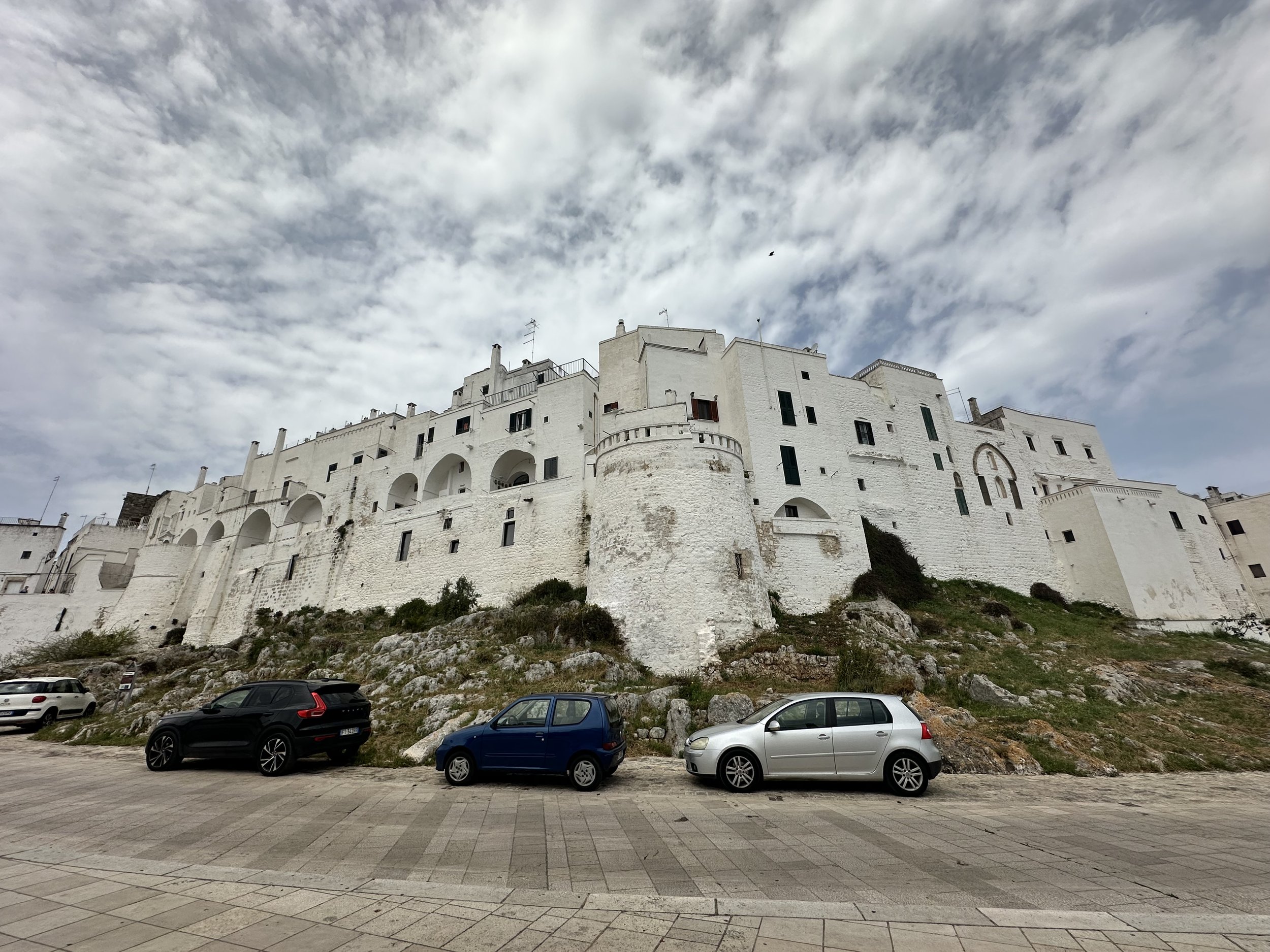
Walking along the road outside the city walls of Ostuni. The best place to stay and see the views are from the resort just outside the City walls.
Finding the shop
We went to the old town first for our mandatory morning espresso, and wandered around the streets before making our way to the main piazza. Along the way there were numerous shops selling local products, in this case the most famous being the local olive oil. I knew I wanted to find a skincare product made with the local olives. The olives here are known to be exceptionally high in polyphenols, a powerhouse of anti-aging actives. The extra virgin olive oil is also a significant source of the antioxidant, squalene. After checking out a couple of olive oil producers’ shops, I came to L’alia near Piazza della Liberta. It was a small shop with olive oils on one wall and olive oil based skin care products on the opposite wall.
There on the back wall was the Creme Viso, which is Italian for face cream. I have been without a good night cream for months, just using serums here and there. I picked up a small jar, along with an olive oil lip balm. The merchant was an older man who looked like he had spent a lot of time out in the sun over the years. He had a very sweet dad vibe, and threw in an olive sample soap to go with my purchase. As it turns out, the skin care products are developed by the daughter of the family run Tanzarella Guiseppe Azienda Agricola, an olive oil farm.
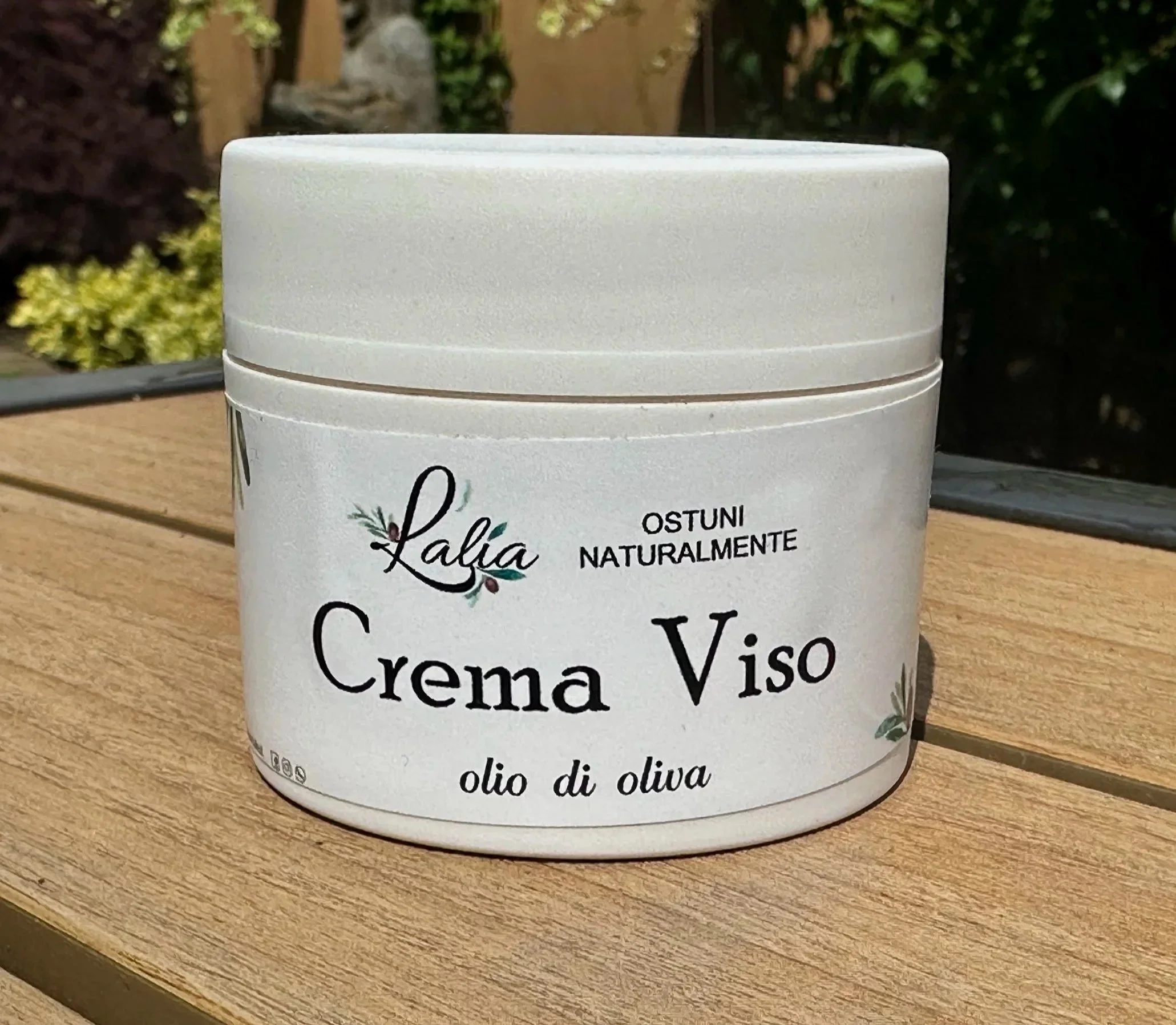
A luscious face cream from a local olive oil farm apothecary.
Visiting the olive groves
One of the top experiences on our list was to see the Millenial Olive trees. The countryside surrounding Ostuni is known for olive oil production, including from ancient trees, with some of them being more than 2,000 years old. The millennial trees are easy to spot, they have wide trunks, often gnarled looking but and are still producing olives for harvest. We were able to stop and get an olive oil tasting and pick up several liters of olive oil from two different farms, including Antica Masseria Brancati and Olio Sante, just outside of Ostuni, before heading back to Monopoli.
Crema Viso Review
I started using my face cream once I returned home. It was lightweight and luscious but not oily. The scent was very mild. My skin immediately calmed, redness disappeared. My skin was just..happy. It became my nightly face cream, and part of my evening ritual. Because I had only a small jar and no way to buy more, I used it sparingly, to try and stretch it out as long as possible. The result:
Within a month, the product had spoilt…it developed a strange smokey smell that could not be ignored. Like cigarettes. It had a “good for 6 months after opening” symbol on it, it should have lasted much longer. Did the preservative fail or was the product sitting too long on the shelf before being purchased? Did I just buy a lemon? At 30+ Euros for a 50ml (~1.7 oz) jar, it was not cheap but also not terribly expensive, compared to what a high end brand would charge for something similar. Upon further examination of the jar, and a little help from Google translate, I was able to find that this product was made by Laboratory Natural BEL, a natural cosmetics manufacturer in the Ancona region farther to the north, on behalf of L’Alia by Tanzarella Giuseppe. They make personalized products using the client’s ingredients. The primary preservative used is naturally occurring in nature, but the EU limits its use to 1% of the formulation. There are a list of ingredients on the label that are great for the skin but microbes can thrive in if the preservative is not robust, like aloe, floral water and botanical extracts.
So what lesson can can be learned here? - C’est la vie! Oh wait, that’s French…I will still try out the local products but will not use sparingly next time. Perhaps we should expect natural products not to last as long as their synthetic counterparts. Before we had many synthetic chemicals to help extend the life of cosmetic products, cold creams used to be sold in small containers because they were not expected to last long. That is the trade off for avoiding synthetic chemicals.
There is another option, of course. Anhydrous products don’t need preservatives, just some vitamin E or other anti-oxidant to keep them from going rancid. We can also avoid emulsifier chemicals altogether by keeping the water and oil phase ingredients separate until use. Don’t get me wrong, I’m still totally going to try and recreate this olive oil face cream. I have liters of Puglian olive oil to use btw…but it will only be for personal use, since by the time the person I gift this to decides to use it, it may have already gone bad. (unless of course it turns out amazing and you REALLY want to try it! I’ll keep you posted!). I’m already testing out different types of natural preservatives and emulsifiers.
Crafting a solution
Before I dive into using my precious stash of Puglian olive oil. I will work on perfecting a lotion recipe using natural preservatives and emulsifiers. I already wanted to create a lotion with my English rose hydrosol. The scent is too heavenly not to find more uses for it…I currently have a a little experiment going, which I started in my kitchen comparing the emulsifiers, milliard emulsifying wax to sunflower lecithin. The lecithin lotion separated on me and the emulsifying wax was not as natural as marketed, so now I will also be trying olivem 1000 emulsifier next. It’s a natural emulsifier derived from olives.
Lotion Experiment Base Recipe
Ingredients, % by weight
Water Phase:
Rose Hydrosol 60%
Distilled Water 8%
Glycerine 2%
Oil Phase:
Jojoba Oil 15%
Mango Butter 8%
Emulsifier 2%
Cool-Down Phase:
Vitamin E (Tocopherol) 0.5%
Preservative - Control=0, Leucidal SF Max 2%, Geoguard ECT 1%
Distilled Water (fill to 100%)
For preservatives, I’m testing Geoguard ECT vs Leucidal SF Max. Leucidal is an antibacterial peptide preservative derived from the probiotic Lactobacillus, the same used to make kimchi and sauerkraut. Could be interesting. So far it seems to be enhancing the hydrosol’s floral scent better than Geoguard. After the first week it was still a close call. Both options are considered natural. You just have to be careful to buy it from a reputable supplier and not a knock-off that could be made synthetically. We’ll see which one preserves my creation the longest!
After two weeks there wasn’t much change yet. I was surprised that the control samples, which contained no preservative, showed no signs of spoilage yet.
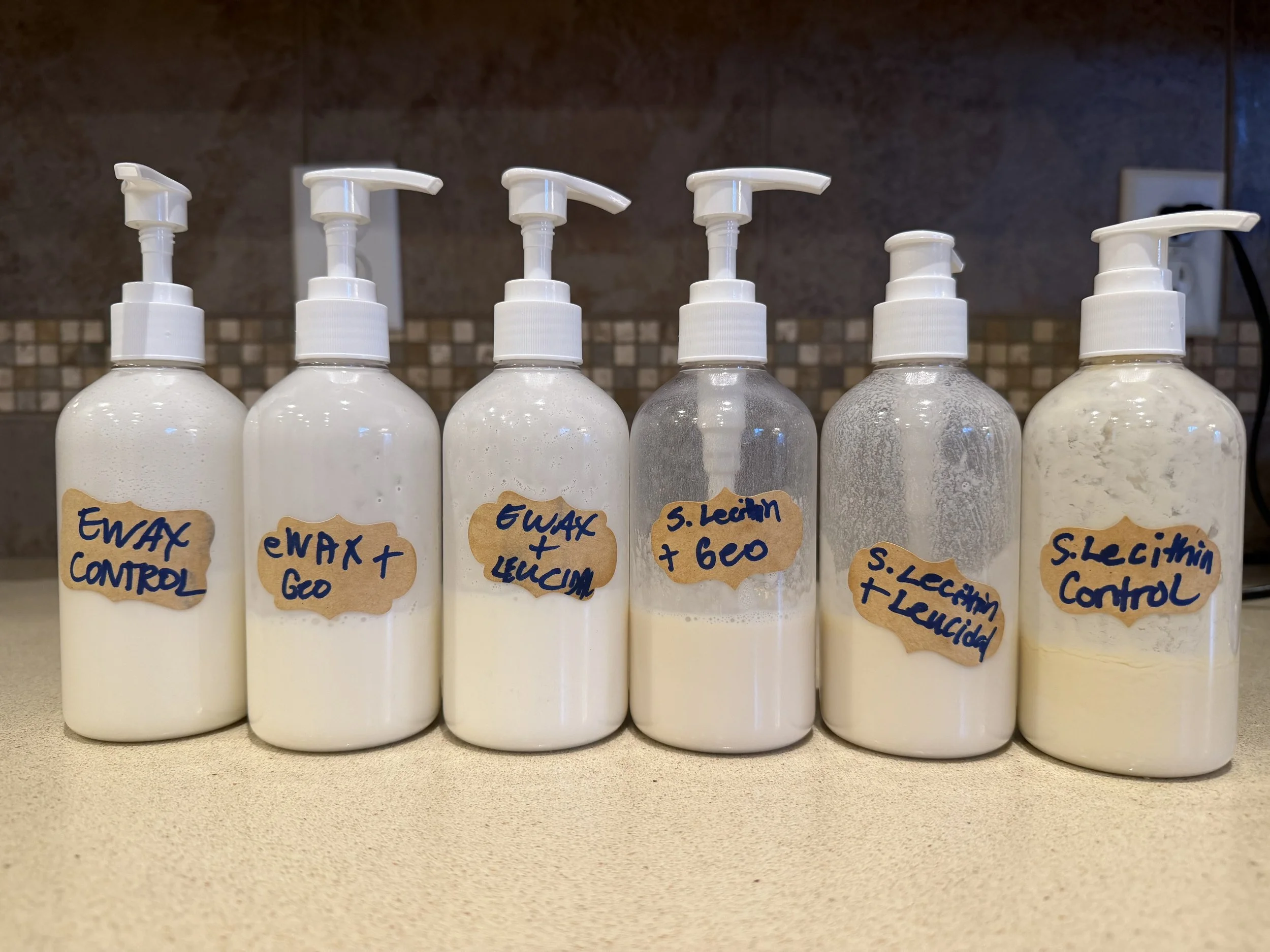
The test batch samples. The sunflower lecithin gives the lotion a darker color. I probably needed 3x the amount to keep it from separating. I can’t imagine how much darker it would be in that case. Perhaps it would work well for suncare!
After one month, two of the Sunflower Lecithin test samples had spoiled and fizzed upon opening the bottle. One was the control sample which was expected by this time, and the second was the sample with Leucidal as the preservative. It’s likely that the failure of the emulsion also affected the efficacy of the preservative. The failure of the emulsion likely left water pockets in the solution that allowed for microbial growth. This result also tells me that Geoguard is the stronger of the two preservatives, as it still has not spoiled even with a failed emulsifier. The emulsifying wax control sample was showing signs of turning due to an odd chemical smell, like crayons. The top two scoring test samples were the lotion made with emulsifying wax and Leucidal. It retained the delicate rose scent the best of all samples, had the best texture, and was the desired thickness without having to add a thickener like cetyl alcohol. The sample with Ewax + geoguard preservative seemed to mute the rose scent, but had a nice texture and came in second.
This experiment was a lot of work but will help inform my future recipes. I’ll likely try making an olive oil face cream with a locally sourced olive oil (hello Costco!) and see how it goes, experiment with Olivem emulsifier, and try both preservatives to see if the resulting scent is desirable and the lotion remains stable before trying it with my Puglian olive oil. I’ll be sure to post any updates to my social media, so be sure to follow me there. Ciao!
